
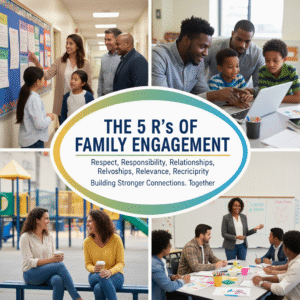
The 5 R’s of Family Engagement is a framework that helps schools, youth organizations, and community programs build strong, mutual relationships with families through five core principles: Respect, Responsibility, Relationships, Relevance, and Reciprocity. It provides a clear structure for collaboration that values every family as a partner in children’s development and learning.
In other words, the 5 R’s define how educators and families can work together effectively. By emphasizing mutual trust and shared accountability, the model goes beyond “parent involvement” to focus on authentic engagement and co-creation.
Key Characteristics of the 5 R’s Framework
- Respect
Respect means honoring each family’s culture, beliefs, and experiences. Schools treat parents as experts on their children. This principle encourages inclusive practices such as multilingual communication and culturally responsive teaching. According to the Harvard Family Research Project (2022), programs that embed respect show up to 20% higher family participation rates.
Takeaway: Respect builds the foundation for trust and long-term collaboration.
- Responsibility
Responsibility refers to shared accountability for student growth and well-being. Families and organizations commit to consistent communication and support structures—like joint goal setting and progress updates. This mutual responsibility reinforces equity by ensuring both sides invest in outcomes.
Takeaway: Engagement succeeds when both families and educators take ownership of results.
- Relationships
Relationships form the heart of the framework. They are built on trust, empathy, and regular collaboration rather than one-time meetings. Research from Search Institute (2023) shows students with strong family-school relationships are 30% more likely to demonstrate positive behavior and attendance.
Takeaway: Consistent relationship-building turns families into long-term partners.
- Relevance
Relevance means that all communication and resources must meet the real needs of families. This includes translating information, providing practical guides, and connecting learning to daily life. When families see relevance, engagement activities have higher attendance and satisfaction scores (U.S. DOE, 2024).
Takeaway: Tailoring resources to families’ lived realities keeps engagement meaningful.
- Reciprocity
Reciprocity recognizes that engagement is a two-way process. Families not only receive information but also contribute ideas and feedback that shape programs. Co-created initiatives have been linked to 15% higher student achievement (Weiss et al., 2022).
Takeaway: When families and educators learn from each other, everyone benefits.
How the 5 R’s Framework Works in Practice
In practice, organizations apply the 5 R’s through structured actions:
- Respect: Train staff in cultural competency and active listening.
- Responsibility: Establish shared goals and data-informed progress meetings.
- Relationships: Create ongoing touchpoints—home visits, family cafés, and peer mentoring.
- Relevance: Align resources with families’ daily needs (e.g., bilingual materials or transportation support).
- Reciprocity: Invite families to co-design events and offer continuous feedback loops.
These steps help transition from transactional interactions to transformational partnerships.
Common Misconceptions About Family Engagement
- Myth: Family engagement is just attending school events.
Reality: It involves shared decision-making and strategic collaboration. - Myth: Only parents are involved.
Reality: Caregivers, grandparents, and community members all play critical roles. - Myth: Engagement is the school’s responsibility alone.
Reality: Effective partnerships depend on mutual effort and communication.
The 5 R’s vs. Other Family Engagement Models
Unlike traditional parent involvement models that emphasize volunteering and attendance, the 5 R’s focus on relational equity and shared learning. It aligns closely with Henderson and Mapp’s Dual Capacity Building Framework (2019), which stresses mutual capacity growth for families and schools. The 5 R’s complement this model by translating theory into five practical behaviors.
Why the 5 R’s Matter for Educators and Communities
Strong family engagement improves academic performance, social-emotional skills, and community cohesion. A 2024 meta-analysis from the National PIRC Network found that schools implementing structured engagement frameworks saw a 12–18% increase in student achievement over three years.
For educators, the 5 R’s offer a scalable model to align family voices with organizational goals. For families, they affirm agency, voice, and respect within education systems.
In summary: The 5 R’s of Family Engagement turn good intentions into sustainable partnerships that benefit children and communities alike.
Sources
- Harvard Health Publishing (2024) – Family meals and nutrition outcomes
- Centers for Disease Control and Prevention (2023) – Physical activity guidelines
- Sleep Foundation (2024) – Screen time and sleep correlation
- American Psychological Association (2022) – Gratitude and emotional well-being
- Behavioral Science Journal (2023) – Habit tracking and adherence
- Stanford Behavioral Health (2024) – Parental modeling effects
- Nature Wellness Report (2024) – Outdoor time and mental health